How Climate Zone Quietly Adds 10–30% to Your Build Cost
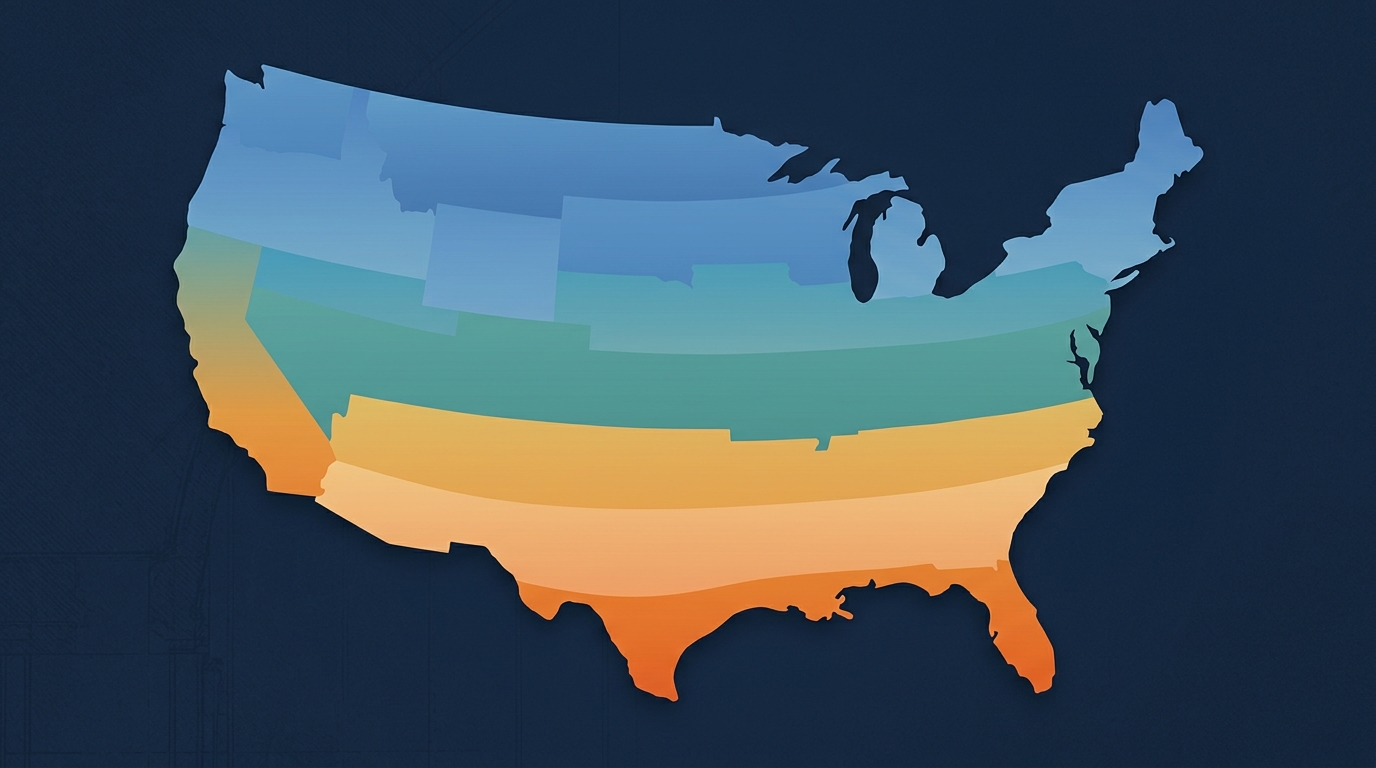
Most contractors price labor and materials carefully. Fewer think about climate zone. Yet the IECC climate zone where a project sits drives a stack of code-required line items — wall and attic insulation, HVAC sizing, window U-values, vapor barriers, and air-sealing requirements — that can quietly add 10–30% to the cost of an envelope compared to the same house built one or two zones warmer.
If you build only in your home market, you've internalized this without realizing it. If you bid across state lines, or quote for a homeowner who's comparing CostKit to a number from a different region, climate-zone awareness is the difference between an estimate that wins and one that loses money.
What is a climate zone, exactly?
The International Energy Conservation Code divides the US into eight climate zones, numbered 1 (hot, humid — south Florida) through 8 (subarctic — interior Alaska). Each zone is further split into moisture sub-classes (A = moist, B = dry, C = marine). Your local building department adopts these zones into the energy code your permit office enforces — typically a version of the IECC, sometimes amended (Title 24 in California, stretch codes in Massachusetts and Vermont, MEC in Texas).
The zone determines, by law, how much insulation goes in the walls, attic, and floor; how airtight the building must be (measured in air changes per hour); and what minimum efficiency a furnace, heat pump, or AC unit must hit.
The four line items that move with zone
1. Insulation
The biggest single delta. Zone 2 (Houston) requires roughly R-13 walls and R-38 attic. Zone 7 (Minneapolis, Bismarck) requires R-21 walls and R-49 attic. That's not just thicker batts — it's often a deeper wall assembly, continuous exterior rigid foam, or spray foam to hit the same R-value without losing interior floor space.
| Zone | Example city | Wall R-value | Attic R-value | Typical insulation premium (per 2,000 sqft) |
|---|---|---|---|---|
| 2 | Houston | R-13 | R-38 | Baseline |
| 4 | Nashville | R-20 | R-49 | +$1,400 |
| 5 | Denver, Boston | R-20 + 5ci | R-49 | +$2,800 |
| 6 | Burlington, Chicago | R-20 + 5ci | R-49 | +$3,200 |
| 7 | Minneapolis, Bismarck | R-21 + 7ci | R-49 | +$4,600 |
The “+ ci” notation means continuous insulation — usually rigid foam on the exterior wall sheathing — and that's where the cost really climbs because it adds a separate trade, longer fasteners, and modified flashing details around every window and door.
2. HVAC sizing and efficiency minimums
A 2,000-square-foot home in Phoenix needs roughly 3 tons of cooling and a small backup heat source. The same house in Minneapolis needs 2.5 tons of cooling and 80,000+ BTU of heat, plus a sealed-combustion or condensing furnace because the IECC sets minimum efficiencies higher in northern zones. The mechanical package alone runs $4,000 to $8,000 more in Zone 7 vs Zone 2 for an equivalent home.
3. Windows and air-sealing
Zone 2 allows U-0.40 windows. Zone 6+ pushes to U-0.30 with low-e and argon fill, and Zone 7+ often calls for triple-pane on north-facing walls. Air-sealing requirements tighten similarly — 5 ACH50 in mild zones, 3 ACH50 in cold zones — which usually means a blower- door test, gasket-sealed top plates, taped sheathing seams, and a dedicated air-barrier trade visit. Add $1,500 to $4,000 for the window upgrade and another $800 to $2,000 for the testing and detailing.
4. Vapor barriers and moisture control
Cold zones need an interior vapor retarder (Class I or II) on the warm side of the wall. Hot-humid zones (1A, 2A, 3A) need the opposite — no interior vapor barrier, often a vented rainscreen — to let walls dry inward. Get this wrong and you've built a wall that grows mold. Get it right and you're adding a half-day of labor and a few hundred dollars of membrane.
State-amended codes are where the real surprises live
The IECC is the baseline. Several states add their own requirements on top:
California (Title 24): Solar panels required on all new residential construction, all-electric heat pump water heater incentives, strict cool-roof reflectance. Adds $10K–$25K to a typical new home.
Massachusetts (stretch code): Roughly 20% more efficient than base IECC. Blower-door testing mandatory.
Florida: Wind-zone overlay on top of the energy code — impact-rated windows or shutters mandatory in HVHZ counties (Miami-Dade, Broward). See our hurricane and flood zone post for the cost detail.
How CostKit handles climate zones
Every state in CostKit is mapped to its dominant IECC climate zone, and the estimate generator pulls insulation R-value requirements, HVAC sizing factors, and known state-amended energy code premiums into the prompt before generating your phase breakdown. A Premium kitchen in Phoenix won't carry the same envelope cost as a Premium kitchen in Burlington — the underlying line items adjust automatically.
You can try it with your next bid: generate a free estimate in two different states and compare the envelope and mechanical lines. The delta is the climate zone working invisibly behind the AI.