Hurricane, Flood & Wind Zone: The Real Cost of Coastal Construction
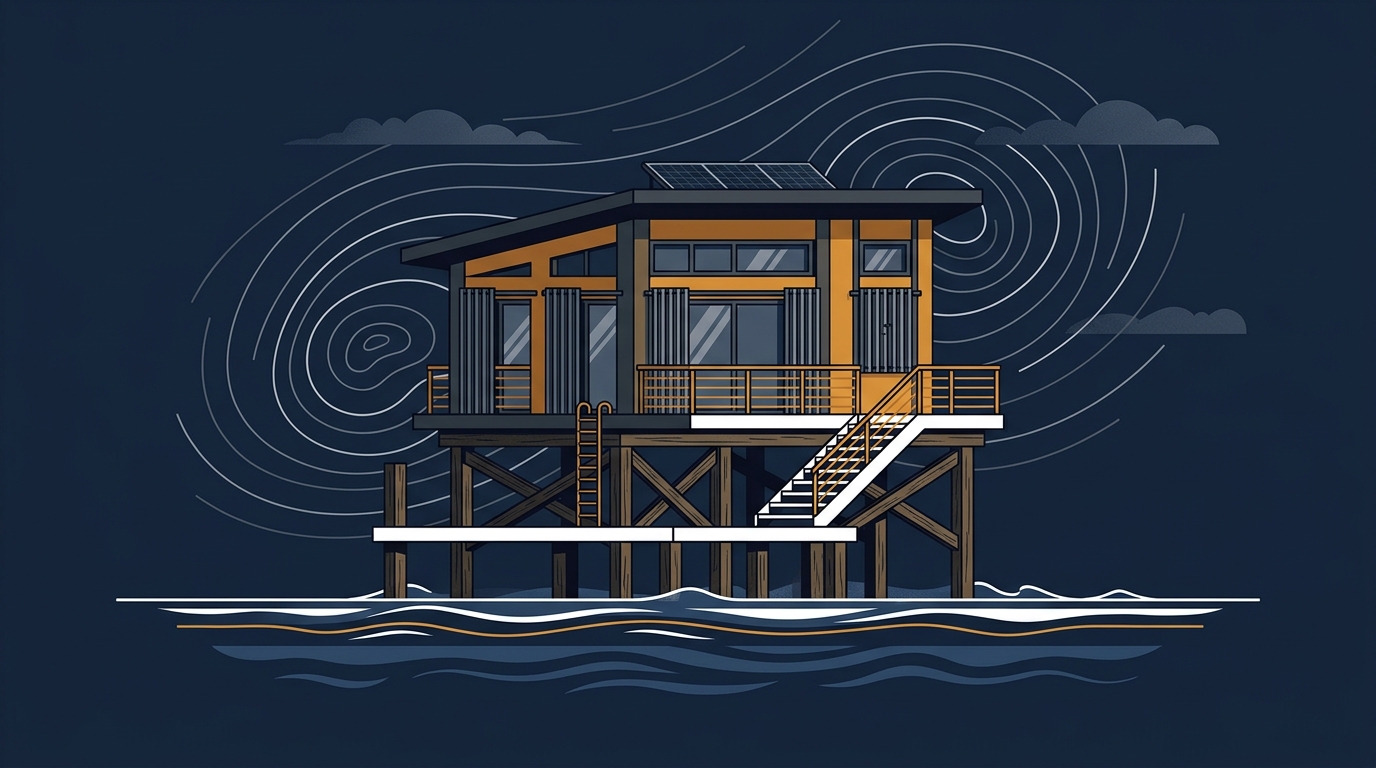
If you're bidding work in a coastal county, a hurricane-prone region, or anywhere in a FEMA-designated Special Flood Hazard Area, your estimate has hard requirements that don't show up in a national cost guide. Skip them and your bid is unbuildable. Pad them generically and you lose to a competitor who priced it right.
Three overlapping zones drive most of the cost: High-Velocity Hurricane Zone (HVHZ), Wind-Borne Debris Region (WBDR), and Special Flood Hazard Area (SFHA). They aren't the same boundary. A jobsite can sit in one, two, or all three, and each carries a different set of code-required upgrades.
High-Velocity Hurricane Zone (HVHZ)
HVHZ is a Florida-specific designation in the Florida Building Code, applied to Miami-Dade and Broward counties. Structures in HVHZ must withstand wind speeds of 175+ mph and a debris-impact test that fires a 2x4 at the window at 50 ft/s. In practical terms:
| HVHZ requirement | Typical cost premium (new build, 2,000 sqft) |
|---|---|
| Impact-rated windows + doors (every opening) | $8,000–$18,000 |
| Reinforced roof framing + hurricane straps at every truss | $2,500–$5,000 |
| Concrete tie-beams, masonry shear walls | $4,000–$9,000 |
| Higher-grade roof underlayment + secondary water barrier | $1,500–$3,000 |
| Engineered drawings + product approvals | $1,500–$4,000 |
| Total HVHZ premium | $17,500–$39,000 |
That's not a markup. It's hard cost — different windows, more steel, more concrete, more drawings. A homeowner moving from Orlando to Miami sees a 15–25% jump in build cost for what looks like the same house, and most of it is HVHZ.
Wind-Borne Debris Region (WBDR)
WBDR is broader than HVHZ. It covers the entire Atlantic and Gulf coast from Texas to North Carolina, plus parts of Virginia and Maryland — anywhere FEMA maps to 140+ mph design wind speeds. WBDR doesn't require the full HVHZ stack, but it does require opening protection:
- Impact-rated windows and doors, or
- Approved storm shutters or panels covering every opening, or
- Plywood panels pre-cut and labeled per opening (allowed in some jurisdictions for one-and-two-family dwellings only)
Plywood is cheapest. Impact glass is most expensive but maintenance-free, and most homeowners now choose impact glass because shutters require deployment before a storm. Budget $8,000–$14,000 for impact windows on a typical home, or $3,000–$6,000 for accordion shutters.
Special Flood Hazard Area (SFHA)
FEMA's SFHA is the 1% annual chance flood zone — what most people call the “100-year floodplain.” About 13% of US land areais in an SFHA, but the proportion is far higher in some states (Florida ~25%, Louisiana ~30%). If your jobsite is inside an SFHA, the lowest floor must be elevated to or above the Base Flood Elevation (BFE) shown on the FIRM map.
Quick rule: 1 foot of elevation above BFE typically reduces flood insurance premium by 30%. Many homeowners ask for 2– 3 feet of “freeboard” even when the code only requires the minimum, because the insurance math compounds over a 30-year mortgage.
Elevation isn't free. A 4-foot stem-wall foundation on a 2,000-square-foot footprint adds roughly $12,000–$22,000 over a slab. Pile foundations (common in coastal NC, SC, FL, LA) add $25,000–$45,000. You also need flood-resistant materials below BFE (no drywall, no fiberglass insulation in the elevated substructure, no electrical other than what's required for the elevator), and break-away walls if you enclose the under-house space.
Seismic zones (briefly)
Seismic isn't hurricane, but it lives in the same family of code-required structural upgrades. The IBC defines Seismic Design Categories A through F, and the cost impact in Category D or E (most of California, parts of Oregon, Washington, Alaska, South Carolina, and the New Madrid zone in Missouri/Arkansas/Tennessee) is similar in magnitude to HVHZ: 5–15% structural premium for shear walls, hold-downs, anchor bolts at the right spacing, and engineered drawings.
How to estimate this without guessing
The cleanest workflow:
- Pull the address on FEMA's flood map viewer to confirm SFHA + flood zone (X, A, AE, VE, etc.) and BFE.
- Check the local building department's wind speed and HVHZ/WBDR designation. For Florida, the Building Code overlay is published per-county.
- Add line items per zone, not as a blanket markup. A homeowner who sees “$12,000 for impact windows” understands. “25% hurricane markup” feels arbitrary.
CostKit reads the project state and detects HVHZ, flood risk percentage, and seismic exposure automatically, and the AI is prompted to include the appropriate cost lines when they apply. If you're building in Tampa, foundation elevation gets called out. If you're in Tulsa, it doesn't. Try generating an estimate in two different coastal states and compare the structural phase line by line — that's the zone math doing its job.